
Physiotherapy guide
Hip labral tear symptoms and the exercises that help
A hip labral tear often causes groin pain, clicking or catching. Many people improve with a structured exercise program. This guide explains the common symptoms and how physiotherapy helps.

What is the labrum?
The labrum is a ring of cartilage around the rim of the hip socket. It deepens the socket and helps seal the joint. It can tear with repeated twisting and deep bending, or alongside hip impingement (FAI), where the shape of the ball or socket makes them pinch together.
What does a labral tear feel like?
- Deep pain in the groin, sometimes at the front or side of the hip
- Pain after sitting for a long time, in deep squats or when getting in and out of a car
- Clicking, catching or a brief locking feeling in the hip
- Pain when twisting or pivoting on the leg
Some people have a tear on a scan and no symptoms at all, so the scan result is only part of the picture. Read more about hip labral tears.
Can a labral tear get better without surgery?
The labrum has a limited blood supply, and a torn section does not usually knit back together. Even so, symptoms settle for many people with physiotherapy, because stronger hip and trunk muscles and better control of movement reduce the load on the sore area. International consensus recommends physiotherapist-led treatment, based on exercise and education, as a first step for active adults with hip-related pain.
Which exercises should I start with?
- Dead bug. Lie on your back with hips and knees bent. Slowly lower one heel towards the floor while keeping your lower back still, then swap sides.
- Four-point leg reach. On hands and knees, straighten one leg behind you to hip height without letting your pelvis tip, then return slowly.
- Side-lying leg lifts. Lie on your good side and lift the top leg slightly behind you with the toes pointing forward, then lower slowly.
- Exercise bike. Ten to twenty minutes with the seat set high enough that your hip does not bend sharply.
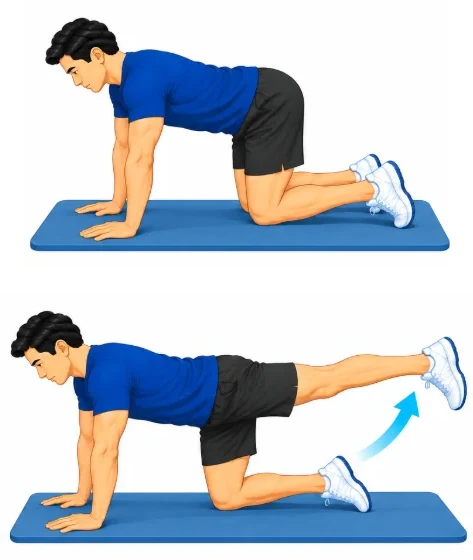
Early on, avoid deep squats, deep lunges and long periods in low chairs, because bending the hip a long way tends to aggravate symptoms. These can be brought back gradually as strength improves.
How long does it take?
Most programs run for at least three months, with the exercises progressed towards running, jumping or sport where those are your goals. Progress is judged by what you can do as well as by pain.
When should I seek medical help?
See a physiotherapist or your GP if hip pain lasts more than a few weeks, if the hip locks or gives way, or if pain at night is getting worse.
When is surgery considered?
If pain keeps limiting daily life or sport after a good trial of physiotherapy, hip arthroscopy may be discussed. Professor Phong Tran performs hip arthroscopy, including labral repair, and consults at the clinic. His website explains hip arthroscopy.
Hip physiotherapy at SOS Clinic
Associate Professor Amir Takla and Imogen Clark are the physiotherapists at SOS Clinic. They work in the same rooms as Professor Phong Tran at 166 Gipps Street, East Melbourne, so care can move between physiotherapy and a surgical opinion without starting again.
More on hip and groin pain
Evidence and further reading
Kemp JL, Risberg MA, Mosler A, Harris-Hayes M, Serner A, Moksnes H, Bloom N, Crossley KM, Gojanovic B, Hunt MA, Ishøi L, Mathieu N, Mayes S, Scholes MJ, Gimpel M, Friedman D, Ageberg E, Agricola R, Casartelli NC, Diamond LE, Dijkstra HP, Di Stasi S, Drew M, Freke M, Griffin D, Heerey J, Hölmich P, Impellizzeri FM, Jones DM, Kassarjian A, Khan KM, King MG, Lawrenson PR, Leunig M, Lewis CL, Marstrand Warholm K, Reiman MP, Semciw A, Thorborg K, van Klij P, Wörner T, Bizzini M. Physiotherapist-led treatment for young to middle-aged active adults with hip-related pain: consensus recommendations from the International Hip-related Pain Research Network, Zurich 2018. Br J Sports Med. 2020;54(9):504-11.
Arrange physiotherapy at SOS Clinic
Visit Specialist Orthopaedic Surgery Clinic at St Francis Building, Ground Floor, 166 Gipps Street, East Melbourne VIC 3002. Bring any relevant scans and a list of the activities you would like to return to.
Book an appointment or call (03) 9928 6161.
This information is general. Follow the advice and precautions provided by your own surgeon and physiotherapist.