Strength and power after 60, and falls
As people get older, muscles slowly get smaller and weaker. Most people notice it in small ways first. Getting out of a low chair takes a push from the arms. Stairs feel harder. A quick step to catch a trip feels slower than it used to.
These changes are common, but they are not fixed. Muscles keep responding to exercise at any age. The right kind of training can help you stay strong, steady and independent.
What is sarcopenia?
Sarcopenia is the medical name for a loss of muscle strength and muscle size that goes beyond what is expected for your age. European experts now describe low muscle strength as its main feature. They also note that it can start earlier in life, not only in old age.1
Sarcopenia raises the chance of falls, fractures and losing independence. The good news is that strength is something you can measure and improve.
Strength and power are different
Strength is how much force a muscle can make. Power is how quickly it can make that force. Lifting a heavy shopping bag needs strength. Stepping out fast to stop a fall needs power.
Research shows that muscle power drops earlier and faster with age than strength does. Power in the legs is also closely linked with how well older people manage daily tasks such as walking, climbing stairs and rising from a chair.2 So a good program trains both. You lift with control, and you also practise moving with some speed when it is safe to do so.
What the research says about strength training
A large Cochrane review pulled together more than 100 trials of progressive strength training in older adults.3 Training two or three times a week made a large difference to muscle strength. It also helped with getting out of a chair. Gains in overall physical ability were smaller on average, and walking speed improved only a little.
Serious problems from the training were rare. Sore muscles and joint aches were common, which is why a program starts at the right level and builds up step by step.
What the research says about falls
The main Cochrane review on exercise to prevent falls looked at more than 100 trials in older people living at home.4 Exercise lowered the number of falls by about a quarter, and this finding was rated as high certainty.
The type of exercise made a difference. Balance and functional exercises, such as standing on one leg, stepping and getting up from a chair, clearly reduced falls. Programs that mixed balance work with strength training probably reduced falls too. Tai chi may also help. For programs of strength training alone, without balance work, the effect on falls was uncertain.4
So strength training helps your muscles and daily function, and balance training is what most clearly helps prevent falls. The best results come from doing both.
What a good program looks like
- It starts with a check. Your physiotherapist tests your leg strength, balance, walking and how you get up from a chair, and asks about any past falls.
- It includes balance work. Exercises challenge your balance safely, often near a bench or wall, and get harder as you improve.
- It builds strength. Leg and hip exercises use body weight, bands or weights, and the load slowly increases.
- It trains power. Once you are ready, some movements are done a little faster, such as standing up briskly from a chair.
- It keeps going. In the falls trials, benefits came from regular exercise over months, and the habit needs to continue.
- It suits your joints. Hip or knee arthritis does not rule out strength or balance training. Exercises are adjusted around your joints.
How SOS Clinic can help
The physiotherapists at SOS Clinic in East Melbourne work with many people over 60 who want to stay strong and steady. Your first visit includes an assessment and a program you can start straight away, in the clinic gym and at home.
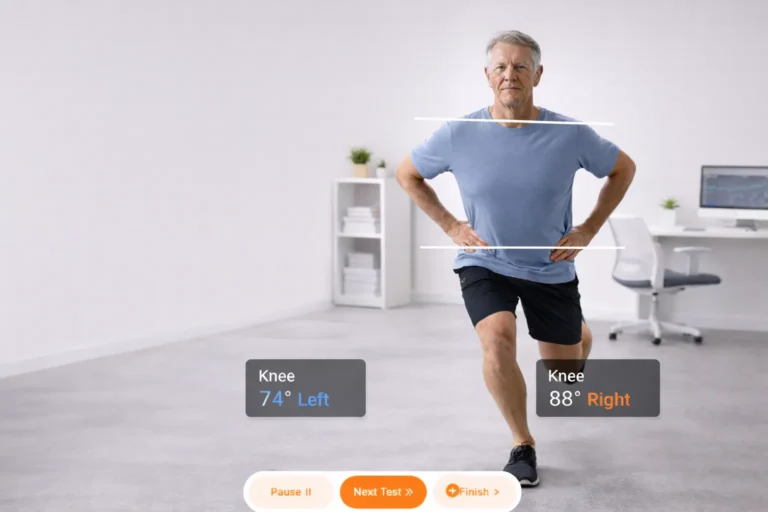
A biomechanical profile assessment can measure your strength and power with VALD equipment. ForceDecks force plates measure how you stand up, balance and push through each leg. The ForceFrame strength frame measures the strength of key muscle groups. The HumanTrak 3D motion camera looks at how you move. Repeat tests show your progress over time.
If arthritis pain is holding you back, your physiotherapist can shape the program around it. If pain keeps limiting you despite a good program, the clinic team can arrange a review with Prof Phong Tran, an orthopaedic surgeon who works from the same clinic.
When to get help sooner
See a doctor promptly if you have a fall and hit your head, cannot get up without help, or have new pain in your hip or groin after a fall. The same applies if falls are happening more often, or you have dizziness, blackouts, new weakness or numbness. Sudden weakness on one side of the body, a drooping face or slurred speech needs an ambulance straight away, so call triple zero. During opening hours, contact the clinic. After hours and on weekends, go to your nearest emergency department.
Book a physiotherapy assessment at SOS Clinic
Frequently asked questions
Am I too old to start strength training?
No. Muscles respond to training at any age. Your physiotherapist starts at a level that suits you and builds from there.
Is walking enough to prevent falls?
Walking is good for your heart and general health. In the falls research, though, the effect of walking alone on falls was uncertain. Balance and strength exercises have stronger evidence.
I have arthritis. Is lifting weights safe?
For most people, yes. In the strength training review, people with osteoarthritis reported less pain after training.3 Exercises are chosen and adjusted to suit your joints.
How often should I exercise?
Many of the trials used two or three sessions a week of strength work, with balance exercises done often. Your physiotherapist sets a plan that fits your week.
Do I need a referral to see a physiotherapist?
No. You can book directly. If you have a GP management plan, Medicare may cover part of the cost of a limited number of visits.
References
- Cruz-Jentoft AJ, Bahat G, Bauer J, Boirie Y, Bruyère O, Cederholm T, Cooper C, Landi F, Rolland Y, Sayer AA, Schneider SM, Sieber CC, Topinkova E, Vandewoude M, Visser M, Zamboni M. Sarcopenia: revised European consensus on definition and diagnosis. Age Ageing. 2019;48(1):16-31.
- Reid KF, Fielding RA. Skeletal muscle power: a critical determinant of physical functioning in older adults. Exerc Sport Sci Rev. 2012;40(1):4-12.
- Liu CJ, Latham NK. Progressive resistance strength training for improving physical function in older adults. Cochrane Database Syst Rev. 2009;2009(3):CD002759.
- Sherrington C, Fairhall NJ, Wallbank GK, Tiedemann A, Michaleff ZA, Howard K, Clemson L, Hopewell S, Lamb SE. Exercise for preventing falls in older people living in the community. Cochrane Database Syst Rev. 2019;1(1):CD012424.