
Physiotherapy guide
Rotator cuff tendinitis exercises you can do at home
A simple, progressive exercise plan is the main treatment for rotator cuff tendinitis. This guide explains how to start, how hard to push and when to get help.

Why does exercise help rotator cuff tendinitis?
Rotator cuff tendinitis, also called rotator cuff related shoulder pain, happens when the tendons around the shoulder are asked to do more than they can currently handle. Rest settles the pain for a while, but it also lets the tendons weaken, so the pain tends to come back. Loading the tendons gradually makes them stronger and better able to cope with everyday tasks.
Exercise works well even without a lot of equipment. In a UK trial, people who did a single exercise at home, progressed over time, did about as well as people who had usual physiotherapy.
How much pain is okay during exercise?
Some discomfort is fine. A practical guide is to keep pain during exercise at around 3 to 5 out of 10, and for it to settle back to your usual level by the next morning. If the shoulder is worse the next day, go back a step and build up again more slowly.
Which exercises should I start with?
- Outward and inward holds. Stand with your elbow tucked in and bent to a right angle. Press the back of your hand, then the palm, gently into a wall or door frame and hold each for 20 to 30 seconds. Repeat five times.
- Side-lying outward rotation. Lie on your good side with a small towel under the elbow of the sore arm. Slowly turn the forearm up towards the ceiling, then lower over three seconds. Start with no weight and add a light one as it gets easier.
- Resistance band rows. Pull a band back with both elbows close to your sides, gently drawing the shoulder blades back, then return slowly.
- Wall slides. Facing a wall, slide both hands up as far as is comfortable, then slowly back down.
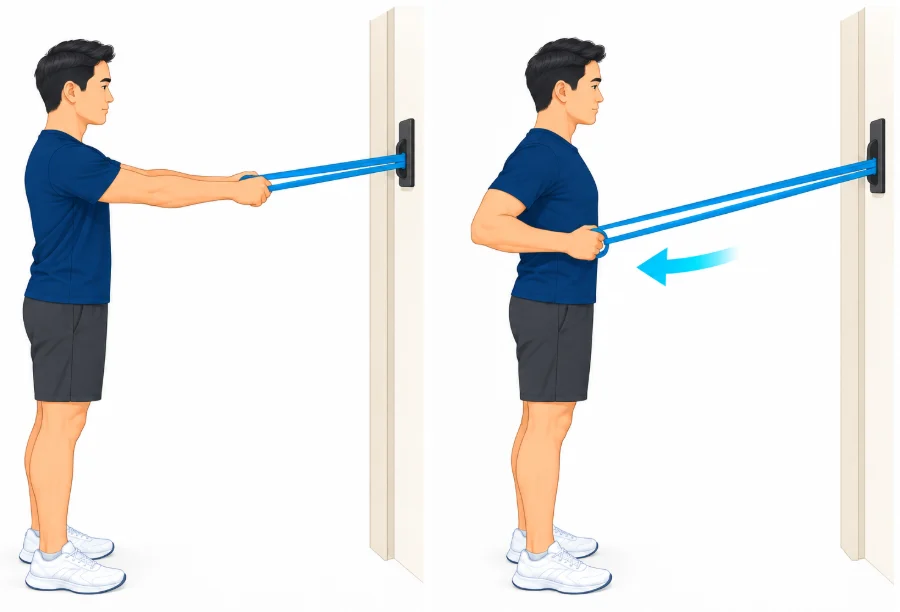
For the strengthening exercises, aim for three sets of 8 to 15 repetitions, three or four times a week. Choose a resistance that makes the last few repetitions feel hard.
How do I progress the exercises?
Every one to two weeks, if the shoulder is coping, make one change at a time. Add a little weight or a stronger band, then do the exercise with the arm further away from the body, then move towards reaching overhead and the movements your work or sport needs.
What can I change in everyday life?
Keep using the arm, but break up long periods of overhead work. Move things you use often down to shoulder height. If lying on the sore side hurts, sleep on the other side with a pillow under the arm, or on your back with a pillow under the elbow.
How long until it improves?
Most people notice a change within six weeks and keep improving over three months. Tendons adapt slowly, so doing the exercises steadily works better than doing a lot on one day.
When should I seek medical help?
See a physiotherapist or your GP if the pain started after a fall or heavy lift and you cannot lift the arm, if pain wakes you every night, or if there is no improvement after six weeks of exercise. These can be signs of a tear or another problem that needs assessment.
What about injections?
A corticosteroid injection can ease pain for a few weeks so you can keep exercising, but it does not strengthen the tendon. Injections are not given at the clinic. If one is recommended, your GP can arrange it, usually through a radiology practice.
Shoulder physiotherapy at SOS Clinic
Associate Professor Amir Takla and Imogen Clark are the physiotherapists at SOS Clinic. They work in the same rooms as Professor Phong Tran at 166 Gipps Street, East Melbourne, so care can move between physiotherapy and a surgical opinion without starting again.
More on rotator cuff problems
- Rotator cuff tendinitis
- Physiotherapy for rotator cuff pain
- Rotator cuff tear
- Shoulder physiotherapy
Evidence and further reading
Lewis J. Rotator cuff related shoulder pain: assessment, management and uncertainties. Man Ther. 2016;23:57-68.
Littlewood C, Bateman M, Brown K, Bury J, Mawson S, May S, Walters SJ. A self-managed single exercise programme versus usual physiotherapy treatment for rotator cuff tendinopathy: a randomised controlled trial (the SELF study). Clin Rehabil. 2016;30(7):686-96.
Arrange physiotherapy at SOS Clinic
Visit Specialist Orthopaedic Surgery Clinic at St Francis Building, Ground Floor, 166 Gipps Street, East Melbourne VIC 3002. Bring any relevant scans and a list of the activities you would like to return to.
Book an appointment or call (03) 9928 6161.
This information is general. Follow the advice and precautions provided by your own surgeon and physiotherapist.