
Physiotherapy guide
How to sit, sleep and walk with hip bursitis
Pain on the outside of the hip is often driven by pressure on the gluteal tendons. Small changes to how you sit, sleep and stand can calm it down while exercise builds strength.

Why does position affect outer hip pain?
The gluteal tendons wrap around the bony point on the side of the hip. When the thigh crosses towards the other leg, these tendons are squeezed against the bone. That compression is a common reason the pain flares at night, when sitting with the legs crossed and when standing with your weight on one hip.
Most outer hip pain that is called bursitis comes mainly from these tendons, a problem known as gluteal tendinopathy. Read more about hip bursitis.
How should I sleep?
Lying on the sore side presses directly on the tendons. Lying on the other side can also hurt, because the top leg drops across the body and squeezes them. Try lying on your back, or on the good side with one or two pillows between your knees and ankles so the top leg stays level. A soft mattress topper can also ease pressure on the sore hip.
How should I sit?
Avoid crossing your legs or knees. Choose a chair high enough that your hips are level with or slightly above your knees, because low, soft chairs and car seats increase compression. Keep your knees about hip-width apart and get up and move every 30 to 45 minutes.
What about standing and walking?
Stand with your weight spread evenly through both feet instead of hanging on one hip. On walks, shorter steps and a steady pace are usually easier than long strides. Stairs and hills tend to flare symptoms early on, so build them back in gradually. Holding a rail on stairs can take some load off the sore side.
Which exercises should I start with?
- Wall hip press. Stand on the sore leg, side-on to a wall, with the other knee lifted and pressing gently into the wall. Stand tall and hold for 30 seconds. Repeat five times.
- Bridges. Lie on your back with your knees bent and feet flat. Lift your hips, hold for three seconds, then lower slowly.
- Sit to stand. Stand up from a firm chair without using your hands, keeping your knees in line with your feet, then sit down slowly.
- Step-ups. Step onto a low step with the sore leg, keeping your pelvis level, and step down slowly.
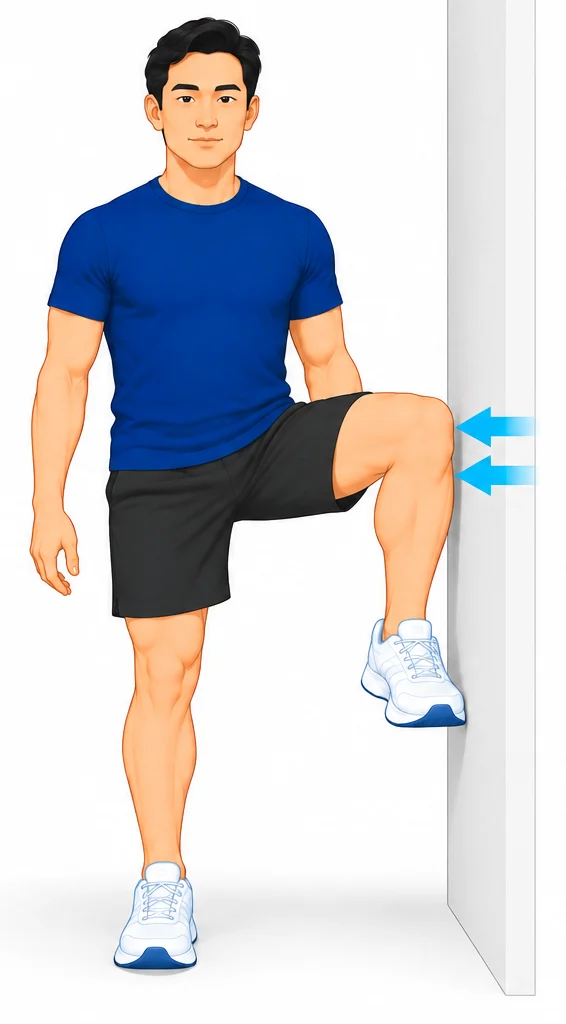
Start with the wall press and two or three of the others on most days. As they get easier, add repetitions, then a little weight.
How long does it take to settle?
In an Australian trial, a program of education and exercise gave better results at eight weeks than a cortisone injection or a wait-and-see approach. Most people improve over 8 to 12 weeks, and pain that has been there for a long time can take longer.
When should I seek medical help?
See a physiotherapist or your GP if pain stops you sleeping most nights, if the pain is in the groin instead of on the side of the hip, or if you notice weakness or a limp that is getting worse. Groin pain can point to a problem inside the hip joint.
What about injections?
A corticosteroid injection can ease pain for a few weeks so you can keep exercising, but it does not strengthen the tendon. Injections are not given at the clinic. If one is recommended, your GP can arrange it, usually through a radiology practice.
Hip physiotherapy at SOS Clinic
Associate Professor Amir Takla and Imogen Clark are the physiotherapists at SOS Clinic. They work in the same rooms as Professor Phong Tran at 166 Gipps Street, East Melbourne, so care can move between physiotherapy and a surgical opinion without starting again.
More on outer hip pain
Evidence and further reading
Mellor R, Bennell K, Grimaldi A, Nicolson P, Kasza J, Hodges P, Wajswelner H, Vicenzino B. Education plus exercise versus corticosteroid injection use versus a wait and see approach on global outcome and pain from gluteal tendinopathy: prospective, single blinded, randomised clinical trial. BMJ. 2018;361:k1662.
Grimaldi A, Fearon A. Gluteal tendinopathy: integrating pathomechanics and clinical features in its management. J Orthop Sports Phys Ther. 2015;45(11):910-22.
Arrange physiotherapy at SOS Clinic
Visit Specialist Orthopaedic Surgery Clinic at St Francis Building, Ground Floor, 166 Gipps Street, East Melbourne VIC 3002. Bring any relevant scans and a list of the activities you would like to return to.
Book an appointment or call (03) 9928 6161.
This information is general. Follow the advice and precautions provided by your own surgeon and physiotherapist.