How myotherapy works alongside physiotherapy
Many people with a sore back, neck, hip or shoulder wonder if they should see a physiotherapist or a myotherapist. At SOS Clinic the answer is often both. The two work best as a team, each doing a different job.
This article explains what myotherapy is, what the research says about it, and how it fits with an exercise program.
What is myotherapy?
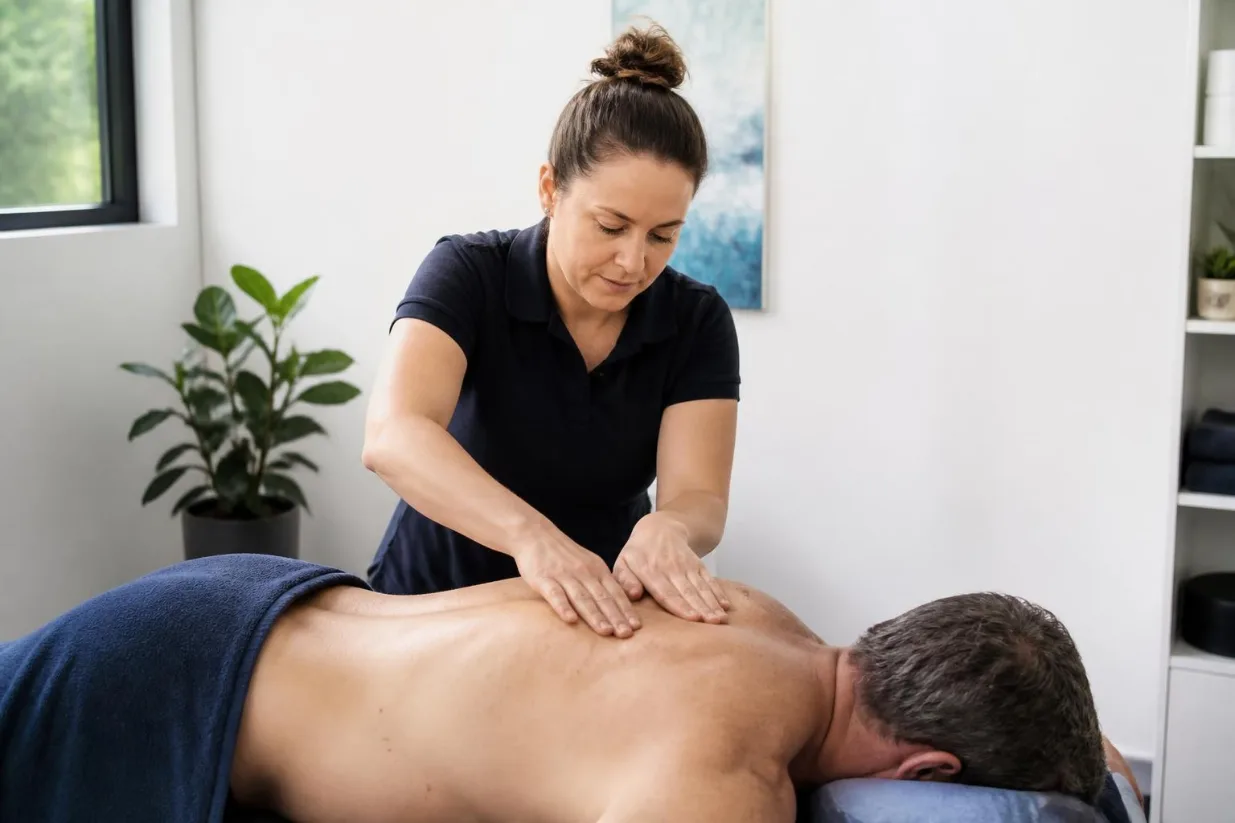
Myotherapy is a hands-on treatment for pain and stiffness in muscles and the soft tissues around joints. A myotherapist assesses how you move, finds the areas that are tight or tender, and treats them.
The main tool is soft tissue therapy. This is a firm, targeted form of massage that works on muscles, tendons and the tissue around them. Treatment often also includes stretching, advice on posture and movement, and simple exercises to do at home.
Some myotherapists also use other techniques. One example is dry needling, where a very fine needle is placed into a tight, tender spot in a muscle. Your myotherapist will explain which techniques suit you and why, and you can always say no to any of them.
How is it different from physiotherapy?
There is some overlap. Both look at how you move and both use hands-on treatment and exercise.
Physiotherapists diagnose injuries and joint problems, and they plan your rehabilitation. Exercise is the core of what they do. They build and progress your strength program, help you return to sport or work, and guide recovery after surgery.
Myotherapists focus on muscles and soft tissue. Their sessions usually have more hands-on time. The aim is to ease pain and tightness so that moving and exercising feel easier.
What does the research say about massage?
The evidence on massage for muscle and joint pain is modest. Large reviews find that massage can ease pain for a short time, often days to weeks. The longer term effects are much less clear.
A Cochrane review of massage for low back pain found that it helped pain in the short term. The effect on day to day function was smaller and less consistent, and the quality of the studies was low.2 A wide review of massage research across many types of pain, including neck, shoulder and back pain, came to a similar view. Massage may help, but the strength of the evidence is low because many studies were small.3
Reviews of dry needling show a similar pattern. It reduces pain in the short term compared with no treatment or a pretend treatment. It does about as well as other hands-on treatments, and there is little good information on longer term results.4
Serious side effects from massage are rare. Some people feel sore for a day or two afterwards.2
Why exercise stays at the centre
Guidelines for common muscle and joint pain agree on a few key points. Care should include education, staying active and exercise. They also say that hands-on treatment should be used alongside other care, and not on its own.1
Exercise has better long term evidence than massage. For ongoing low back pain, for example, a large overview of Cochrane reviews found that exercise reduces pain and helps function, although the average gains are small to medium.5 Strength and fitness also help you keep going once treatment ends.
So myotherapy works best as a support for your exercise program. It can make a stiff, sore area feel easier to move. That can help you start exercises you were avoiding, or get through a flare-up without stopping your program.
How the two fit together
- Same goals. Your physiotherapist and myotherapist agree on what you are working towards, such as walking further, sleeping better or getting back to the gym.
- Hands-on care to help you move. A myotherapy session before or between physio sessions can ease tight muscles, so you can do your exercises with less discomfort.
- Exercise to keep the gains. Your physiotherapist builds strength and control so that relief lasts longer than a few days.
- Less hands-on care over time. As you get stronger and more confident, you usually need fewer treatment sessions.
- Shared notes. Because both work in the same clinic, they can talk about how you are going and adjust the plan.
How SOS Clinic can help
SOS Clinic in East Melbourne has physiotherapy and myotherapy under one roof. The clinic’s myotherapist, Joanne VanDer Haar, works closely with the physiotherapy team.
If you start with physiotherapy, your physiotherapist may suggest myotherapy when tight or sore muscles are holding you back. If you start with myotherapy, you may be referred to a physiotherapist if a joint problem or a weak area needs a structured program. For a detailed picture of your strength and movement, the biomechanical profile assessment uses VALD force plates, a strength testing frame and a 3D motion camera.
When to get help sooner
Muscle soreness is common and usually settles. See a doctor promptly if you have numbness, tingling or weakness in an arm or leg, or new trouble controlling your bladder or bowels. The same applies to pain after a fall or accident, pain with a fever, or a hot, red, swollen calf. Seek urgent care for chest pain or shortness of breath. During opening hours, contact the clinic. After hours and on weekends, go to your nearest emergency department.
Book a myotherapy appointment at SOS Clinic
Frequently asked questions
Do I need a referral to see a myotherapist?
No. You can book directly with the clinic.
Is myotherapy covered by my health fund?
Many private health funds include myotherapy in their extras cover. The amount varies, so check with your fund before your visit.
Will myotherapy hurt?
Some pressure can feel strong, but it should stay within what you are comfortable with. Tell your myotherapist if it is too much. Mild soreness for a day or two afterwards is common.
Can I have myotherapy and physiotherapy in the same week?
Yes. Many people do. Your myotherapist and physiotherapist can help you plan the timing so the sessions support each other.
How many sessions will I need?
It depends on your problem and your goals. Many people feel some change in the first few sessions. The aim is to need less hands-on care as your own exercise program takes over.
References
- Lin I, Wiles L, Waller R, Goucke R, Nagree Y, Gibberd M, Straker L, Maher CG, O’Sullivan PPB. What does best practice care for musculoskeletal pain look like? Eleven consistent recommendations from high-quality clinical practice guidelines: systematic review. Br J Sports Med. 2020;54(2):79-86.
- Furlan AD, Giraldo M, Baskwill A, Irvin E, Imamura M. Massage for low-back pain. Cochrane Database Syst Rev. 2015;2015(9):CD001929.
- Miake-Lye IM, Mak S, Lee J, Luger T, Taylor SL, Shanman R, Beroes-Severin JM, Shekelle PG. Massage for pain: an evidence map. J Altern Complement Med. 2019;25(5):475-502.
- Chys M, De Meulemeester K, De Greef I, Murillo C, Kindt W, Kouzouz Y, Lescroart B, Cagnie B. Clinical effectiveness of dry needling in patients with musculoskeletal pain. An umbrella review. J Clin Med. 2023;12(3):1205.
- Rizzo RRN, Cashin AG, Wand BM, Ferraro MC, Sharma S, Lee H, O’Hagan E, Maher CG, Furlan AD, van Tulder MW, McAuley JH. Non-pharmacological and non-surgical treatments for low back pain in adults: an overview of Cochrane reviews. Cochrane Database Syst Rev. 2025;3(3):CD014691.