
Your home program and how it progresses
Most of the work in physiotherapy happens between visits. Your physiotherapist sets the plan, but your muscles, tendons and joints change because of what you do at home, week after week.
This article explains why a home program helps, how much to do, and how it should get harder over time.
Why the home program does so much of the work
Exercise helps many common problems, such as knee and hip arthritis, back pain and tendon pain. Keeping it up is often the hard part. A Cochrane review on long term muscle and joint pain found that poor follow-through with exercise can limit how much it helps over time.1
A short visit each week or two cannot build strength on its own. Strength and fitness come from regular practice, the same way you learn to play an instrument.
What helps people stick with it
Research on this topic is mixed, and the methods used in studies vary a lot. The approaches below had some support in the trials.
- A program made for you. Exercises that suit your body and goals, with some supervision, may help people keep going.1
- Check-ins with your physiotherapist. In people with hip or knee arthritis, follow-up sessions with a physiotherapist helped people keep doing their exercises.2
- Building up step by step. Starting small and adding a little at a time was helpful in some trials.1,2
- Learning to manage your own condition. Self-management programs improved exercise habits in many of the trials that tested them.1
Some things helped less than expected. Exercise videos or sound recordings on their own did not clearly improve how often people exercised.2
Dose, or how much to do
Exercise has a dose, a bit like medicine. The dose is made up of how hard each exercise is, how many times you repeat it, how many sets you do and how often you train in a week.
Too little and your body has no reason to change. Too much, too soon, and you may flare up. Your physiotherapist sets a starting dose that feels challenging but manageable, then adjusts it as you go.
In knee arthritis research, programs that had one clear focus, were supervised and happened regularly through the week tended to give more pain relief than programs that tried to do a bit of everything.3
Progression, or how it gets harder
Your body adapts to the work you give it. Once an exercise feels easy, it stops pushing you to get stronger. This idea is called progressive overload. Exercise guidelines from the American College of Sports Medicine describe slowly adding load once you can do more than your target number of repeats with good form.4
Progression can happen in many ways. Your physiotherapist might
- add weight or use a stronger band
- add more repeats or sets
- slow the movement down, or hold the hardest point for longer
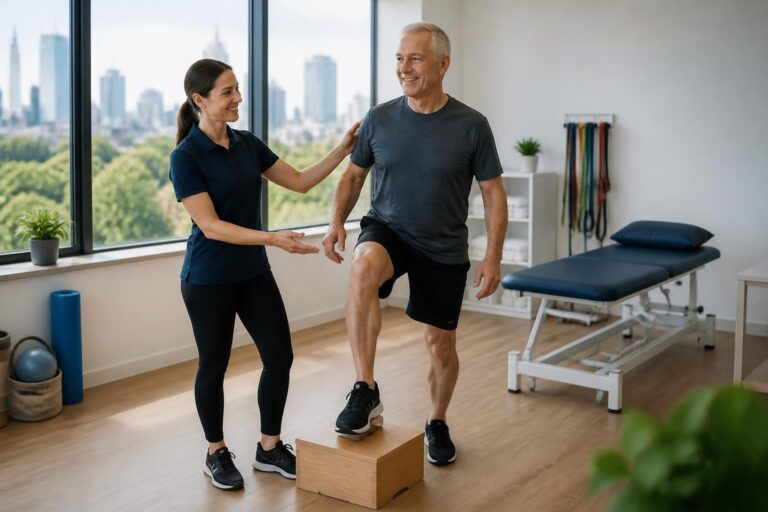
- move from two legs to one leg
- make balance harder, for example on a softer surface
- add speed or a small hop once you are ready
Usually only one or two parts of the program change at a time. That makes it easier to see what your body handles well.
Stronger muscles do not always mean less pain
Getting stronger helps with many daily tasks, but pain does not always follow strength in a straight line. One review of knee arthritis trials found that programs built on proper strength training rules gave bigger strength gains. Pain and function, though, improved about the same as with other types of exercise.5
So your physiotherapist keeps an eye on both. Your strength numbers, your pain and what you can do in daily life all guide how your program changes.
How to tell if the dose is right
Some discomfort during exercise is normal and often expected. As a general guide, discomfort that settles within a day and does not build up week to week usually means the dose is about right. Pain that is sharp, keeps getting worse or lingers for days means the dose needs to come down. Talk to your physiotherapist if you are unsure.
A simple diary helps. Write down what you did and how you felt the next day. It gives you and your physiotherapist real information to work with.
How SOS Clinic can help
The physiotherapists at SOS Clinic in East Melbourne build home programs around your goals, your time and the equipment you have. Exercises are shown and practised in the clinic gym before you take them home.
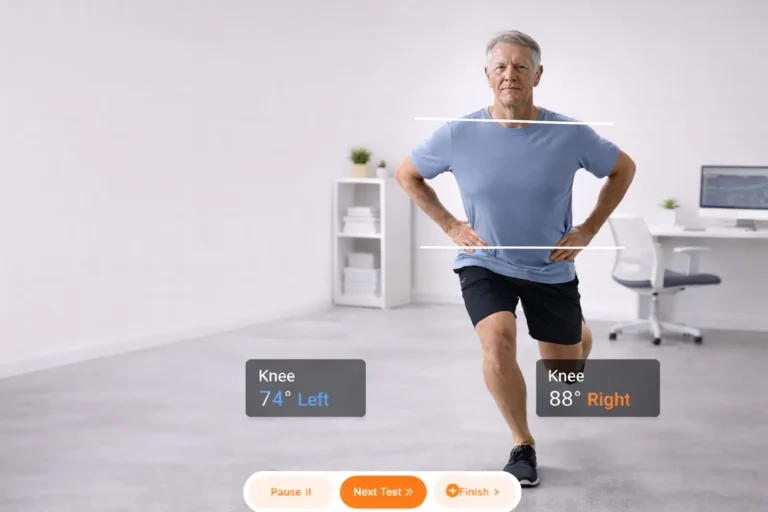
For some people, a biomechanical profile assessment adds measured strength and movement data. Tests on the ForceFrame strength frame and ForceDecks force plates can be repeated over time, so you can see whether your program is building strength and when it is ready to step up.
If you have had surgery, follow your surgeon’s advice on what you can do and when. Your physiotherapist works within those limits.
When to get help sooner
Stop the exercises and contact the clinic if you have pain that keeps getting worse, new swelling, or a joint that locks or gives way. See a doctor promptly if a joint becomes hot, red and swollen, you have a fever, or you have new numbness or weakness. Chest pain, severe shortness of breath or fainting during exercise needs an ambulance straight away, so call triple zero. During opening hours, contact the clinic. After hours and on weekends, go to your nearest emergency department.
Book a physiotherapy assessment at SOS Clinic
Frequently asked questions
How long does it take to get stronger?
Early changes often come from your nerves and muscles learning to work together better. Bigger strength gains build over many weeks of regular training.
What if I miss a few days?
That is normal. Pick up where you left off, or step back a little if it has been a while. Consistency over weeks helps more than any single session.
Should my exercises hurt?
Some discomfort is often fine, as long as it settles within a day and is not getting worse over time. Sharp or rising pain is a sign to ease off and check in with your physiotherapist.
Can I do my program at the gym instead of at home?
Yes. Many people move their program into a gym as it gets harder. Your physiotherapist can adapt it to the equipment you have.
How often should my program change?
It changes when an exercise becomes easy and your body is handling it well. For many people that means small changes every week or two, with a bigger review at each visit.
References
- Jordan JL, Holden MA, Mason EE, Foster NE. Interventions to improve adherence to exercise for chronic musculoskeletal pain in adults. Cochrane Database Syst Rev. 2010;2010(1):CD005956.
- Nicolson PJA, Bennell KL, Dobson FL, Van Ginckel A, Holden MA, Hinman RS. Interventions to increase adherence to therapeutic exercise in older adults with low back pain and/or hip/knee osteoarthritis: a systematic review and meta-analysis. Br J Sports Med. 2017;51(10):791-9.
- Juhl C, Christensen R, Roos EM, Zhang W, Lund H. Impact of exercise type and dose on pain and disability in knee osteoarthritis: a systematic review and meta-regression analysis of randomized controlled trials. Arthritis Rheumatol. 2014;66(3):622-36.
- American College of Sports Medicine. American College of Sports Medicine position stand. Progression models in resistance training for healthy adults. Med Sci Sports Exerc. 2009;41(3):687-708.
- Bartholdy C, Juhl C, Christensen R, Lund H, Zhang W, Henriksen M. The role of muscle strengthening in exercise therapy for knee osteoarthritis: a systematic review and meta-regression analysis of randomized trials. Semin Arthritis Rheum. 2017;47(1):9-21.