
Knee replacement rehab, the milestones and how strength testing tracks them
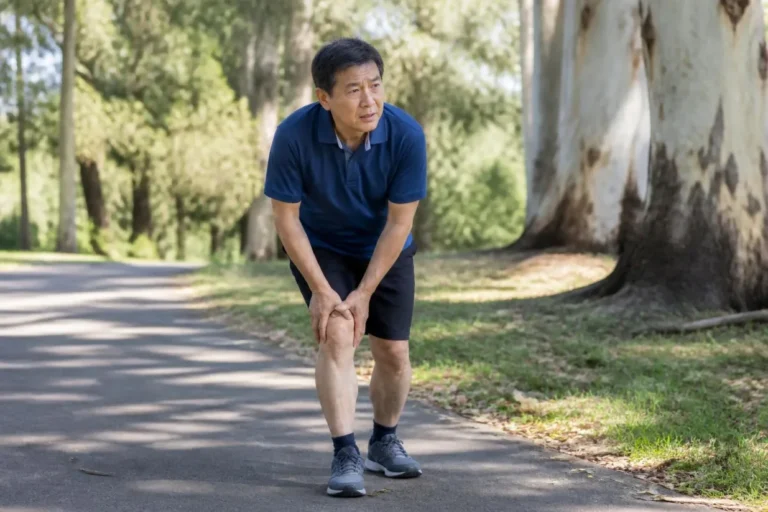
A knee replacement can ease arthritis pain a great deal. Getting the most out of the new knee still takes work. The thigh muscle at the front of the knee, the quadriceps, is weak after surgery, and it can stay weak for a long time if it is not trained.
This article explains the usual stages of rehab, why strength is slow to come back, and how strength testing at SOS Clinic can show your progress. Your surgeon sets your precautions and timelines, so always follow your surgeon’s advice first.
Why the thigh muscle gets so weak
In the first month after a knee replacement, quadriceps strength drops sharply. A study that measured the muscle before and after surgery found that most of this loss came from the nervous system not switching the muscle on fully. Some of it came from the muscle shrinking.1 The same researchers noted that weakness and reduced function are often still present a year after surgery.1
Swelling and pain both make it harder for the muscle to switch on. That is one reason early rehab focuses on calming the knee and getting the muscle working again, before heavier strength work begins.
The usual milestones
Everyone recovers at their own pace. Your surgeon and physiotherapist will guide the timing. These stages give a general picture.
- In hospital and the first days home. Getting in and out of bed, walking with a frame or crutches, tightening the thigh muscle, and gentle bending and straightening.
- Early rehab. Controlling swelling, working on bend and straightening, and walking further. Many people move from a frame to crutches or a stick as their surgeon allows.
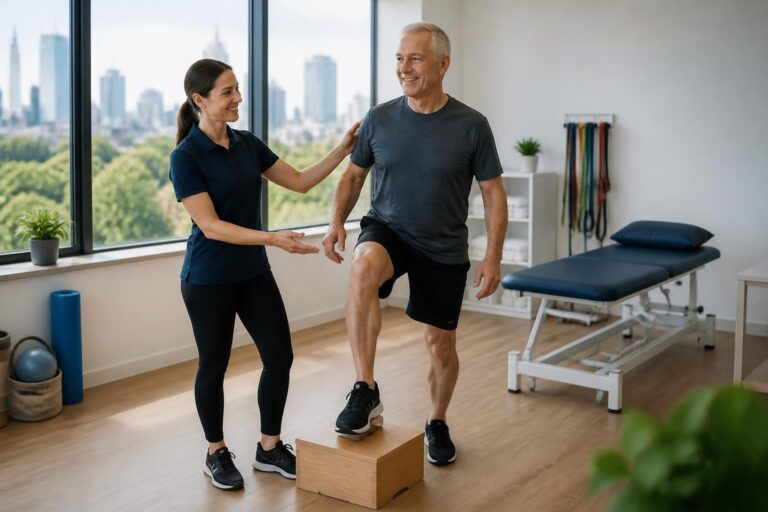
- Building strength. Exercises such as sit to stand, step-ups, mini squats and a stationary bike. Load is added slowly as the knee settles.
- Getting back to daily life. Stairs, longer walks, driving when your surgeon clears it, and returning to work or hobbies.
- Longer term strength. Ongoing strength work so the operated leg keeps catching up with the other side.
Does early and harder exercise help more?
Getting moving soon after surgery and building strength over time are both part of standard rehab. Reviews have found that physiotherapy exercise after knee replacement improves function and pain in the short term, compared with very little physiotherapy.2 The same review found little evidence of long term benefit, and most of the trials were small.2
A more recent review of strength training found it improved mobility and reduced knee pain after knee replacement, without extra risk.3
Harder is not always better in the early weeks. One trial compared a high intensity strength program starting a few days after surgery with a gentler program. Both groups improved strength and function over a year. The harder program was safe, but it did not give better results than the gentler one.4 The authors thought the muscle switch off in the early weeks may limit how much a hard program can achieve at that stage.4
So the aim is steady progress. Exercises get harder as your knee allows, guided by your physiotherapist and your surgeon’s advice.
How strength testing tracks your progress
Feeling stronger and being stronger are not always the same. Many people feel well while their operated leg is still much weaker than the other. Measuring strength helps your physiotherapist plan the next step.
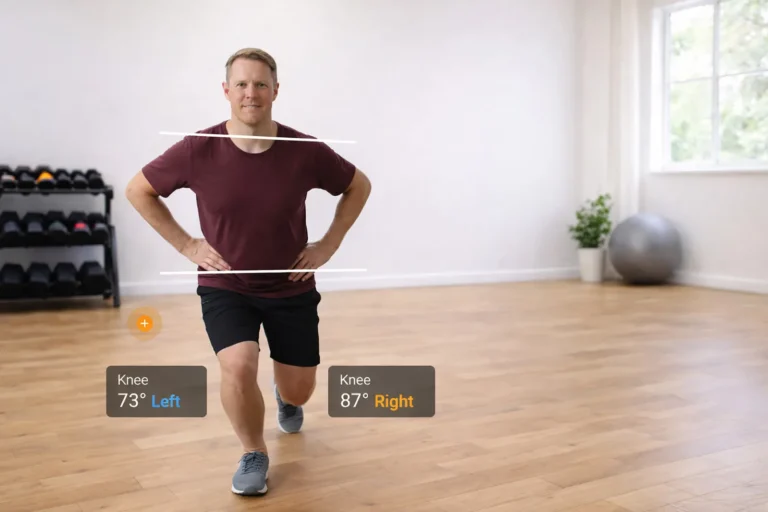
At SOS Clinic, the ForceFrame strength frame measures how hard you can push and pull with each leg, so the thigh and hamstring muscles on both sides can be compared. ForceDecks force plates measure how evenly you take weight through each leg during standing, sit to stand and squat tests.
These tests are done once your surgeon and physiotherapist agree it is safe. Repeating them every few weeks shows whether the operated leg is closing the gap with the other side. Your physiotherapist uses the results, along with how your knee feels and moves, to adjust your program. There is no single number that decides when you are finished.
How SOS Clinic can help
The physiotherapists at SOS Clinic in East Melbourne see people after knee replacement by any surgeon. They work within your surgeon’s plan, and they can liaise with your surgeon if there are any concerns.
A biomechanical profile assessment uses VALD equipment to measure strength, balance and movement, so you can see your progress in numbers.
Prof Phong Tran, who consults from the same clinic, performs knee replacement through a subvastus approach, which reaches the joint by going under the quadriceps muscle. Read about subvastus knee replacement with Prof Phong Tran.
When to get help sooner
Contact your surgeon or the clinic promptly if your wound becomes red, hot or starts to leak, or you have a fever or chills. Seek urgent care if your calf becomes swollen, tender or painful, or you have chest pain or trouble breathing. The same applies if pain suddenly gets much worse or you cannot put weight on your leg. During opening hours, contact the clinic. After hours and on weekends, go to your nearest emergency department.
Book a physiotherapy appointment for knee replacement rehab at SOS Clinic
Frequently asked questions
When can I start physio after my knee replacement?
Rehab usually begins in hospital. Outpatient physiotherapy often starts soon after you go home. Follow your surgeon’s advice on when to start and what to avoid.
How long does it take to recover from a knee replacement?
It varies a lot. Daily tasks often get easier over the first few months, but strength can keep improving for a year or more with regular exercise.
Is it normal for my knee to stay swollen?
Some swelling is common for months, especially after a busy day. Ice, elevation and pacing your activity help. Tell your physiotherapist or surgeon if swelling suddenly increases or comes with redness, heat or fever.
Why is my thigh still weak when my knee feels fine?
Strength often lags behind how the knee feels. Strength testing can show the gap, and a progressive program helps close it.
Can I see an SOS Clinic physio if another surgeon did my knee?
Yes. The physiotherapists see patients after knee replacement by any surgeon and follow that surgeon’s advice.
References
- Mizner RL, Petterson SC, Stevens JE, Vandenborne K, Snyder-Mackler L. Early quadriceps strength loss after total knee arthroplasty. The contributions of muscle atrophy and failure of voluntary muscle activation. J Bone Joint Surg Am. 2005;87(5):1047-53.
- Artz N, Elvers KT, Lowe CM, Sackley C, Jepson P, Beswick AD. Effectiveness of physiotherapy exercise following total knee replacement: systematic review and meta-analysis. BMC Musculoskelet Disord. 2015;16:15.
- Brown RCC, Mora-Traverso M, Fernández-González M, Perez de Arrilucea Le Floc’h UA, Molina-García C, Molina-Garcia P. Efficacy and safety of resistance training for knee osteoarthritis and subsequent knee replacement: a systematic review and meta-analysis. Ann Phys Rehabil Med. 2026;69(5):102122.
- Bade MJ, Struessel T, Dayton M, Foran J, Kim RH, Miner T, Wolfe P, Kohrt WM, Dennis D, Stevens-Lapsley JE. Early high-intensity versus low-intensity rehabilitation after total knee arthroplasty: a randomized controlled trial. Arthritis Care Res (Hoboken). 2017;69(9):1360-1368.