
Hip impingement, what physiotherapy can do
Hip impingement is a common cause of groin and hip pain in active teenagers and adults. It often hurts when you sit for a long time, squat deeply, get in and out of a car or twist on the leg.
Many people with this problem wonder if they need an operation. Large trials have compared hip arthroscopy with physiotherapy-led care. Both helped, and knowing what each can offer makes the choice easier.
What is hip impingement?
The hip is a ball and socket joint. In hip impingement, the ball or the rim of the socket has an extra bump of bone. When the hip bends and turns, the bump can pinch the edge of the socket, including the labrum, a ring of cartilage around the rim.
Experts now call the painful condition femoroacetabular impingement syndrome, or FAI syndrome. An international group agreed in 2016 that the diagnosis needs three parts together. You need hip symptoms, signs on examination and a matching shape on X-ray or scan.1 Many people have the bone shape without any pain, so a scan alone does not make the diagnosis.
The same group agreed that suitable treatments include conservative care, rehabilitation and surgery.1 The SOS Clinic page on femoroacetabular impingement explains the condition in more detail.
Physiotherapy or surgery, what the trials found
The UK FASHIoN trial included 348 people with FAI syndrome.2 Half had hip arthroscopy, a keyhole operation to reshape the hip. The other half had personalised hip therapy, a supervised and progressive program led by a physiotherapist.
At one year, both groups had better hip-related quality of life. The surgery group improved more on average, and the authors judged the difference large enough to matter to patients. Side effects were more common after surgery, and a few people in the surgery group had serious problems related to treatment.2
The Australian FASHIoN trial compared the same two approaches in 99 people.3 Again, both groups improved, and the surgery group reported more improvement in symptoms at one year. Special MRI scans of the hip cartilage showed no clear difference between the groups.
A review of physiotherapist-led treatment for hip-related pain found that it might improve pain and function, with effects that ranged from weak to moderate. The authors called for larger, high quality trials.4
So on average, surgery gave a bigger improvement in these trials. Physiotherapy also helped many people, avoided the risks of an operation and may be enough for some. Not everyone in either group did well, which is why the choice is best made with your own goals and examination in mind.
What a physiotherapy program includes
An Australian trial called PhysioFIRST tested two physiotherapy programs over six months. One focused on targeted strengthening and the other on standard stretching. Both groups improved by a meaningful amount, with no clear difference in hip-related quality of life. The strengthening group gained more hip strength and was more likely to report less pain.5
A program for FAI syndrome usually includes the following.
- Learning about your hip. Knowing which positions pinch the hip helps you manage pain day to day.
- Changing how you load the hip for a while. This may mean sitting a little higher, avoiding very deep squats or adjusting how you train.
- Hip and trunk strength. Exercises for the muscles around the hip and the core, built up slowly over weeks.
- Movement control. Training how your pelvis and leg move during squats, lunges, steps and landing.
- A gradual return to sport. Running, kicking, changing direction and other sport skills are added back step by step.
Most programs in the trials ran for several months. Some soreness during exercise is common and your physiotherapist will adjust the program if pain flares.
If surgery is the right choice
If symptoms do not settle with a good trial of physiotherapy, or you want to talk about surgery, the clinic team can arrange a review with Prof Phong Tran. Read about hip arthroscopy with Prof Phong Tran. After any surgery, follow your surgeon’s advice on precautions and timelines.
How SOS Clinic can help
The physiotherapists at SOS Clinic in East Melbourne assess your hip, back and movement to work out what is driving your pain. You leave your first visit with a plan and exercises you can start straight away.
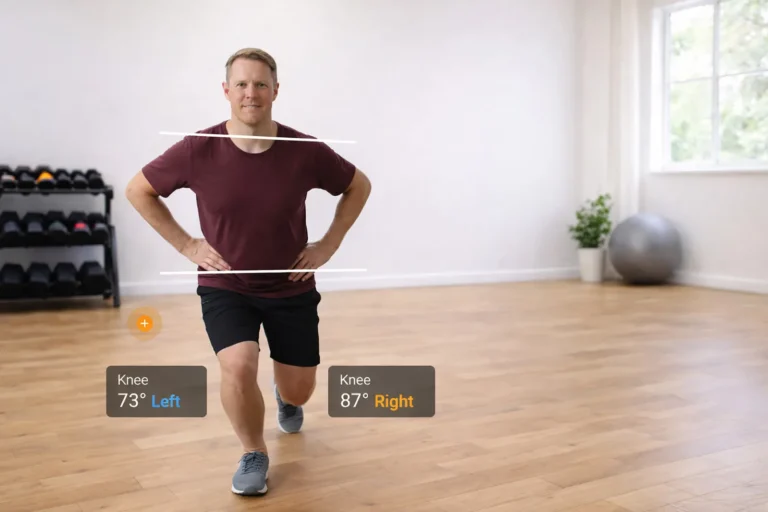
A biomechanical profile assessment measures hip strength with the VALD ForceFrame, jumping and landing with ForceDecks force plates, and squat and lunge movement with the HumanTrak 3D motion camera. Repeat tests show your progress.
Myotherapy can ease tight muscles around the hip, groin and lower back while you build strength.
When to get help sooner
See a doctor promptly if you cannot put weight on your leg, the hip locks or gives way, or you have hip pain with a fever or feel unwell. The same applies to severe pain after a fall, or pain that keeps getting worse at night and at rest. During opening hours, contact the clinic. After hours and on weekends, go to your nearest emergency department.
Book a hip physiotherapy assessment at SOS Clinic
Frequently asked questions
Will physiotherapy change the shape of my hip?
No. Exercise does not remove the bony bump. It aims to make the muscles stronger and help you move in ways that pinch the hip less, so pain eases and you can do more.
Can I keep playing sport?
Often yes, with some changes. You may need to cut back on the moves that hurt most for a while. Your physiotherapist can help you plan a safe way to keep training.
How long should I try physiotherapy before thinking about surgery?
The trials used programs that ran for several months. Your physiotherapist and doctor can help you judge whether you are making progress and when a surgical opinion makes sense.
Does hip impingement lead to arthritis?
Some hip shapes are linked with a higher chance of arthritis later in life. It is not yet known whether surgery or exercise changes that risk.
Is stretching enough?
In the PhysioFIRST trial, a stretching program and a strengthening program both helped. Strengthening gave more gains in hip strength, so most programs include it.
References
- Griffin DR, Dickenson EJ, O’Donnell J, Agricola R, Awan T, Beck M, Clohisy JC, Dijkstra HP, Falvey E, Gimpel M, Hinman RS, Hölmich P, Kassarjian A, Martin HD, Martin R, Mather RC, Philippon MJ, Reiman MP, Takla A, Thorborg K, Walker S, Weir A, Bennell KL. The Warwick Agreement on femoroacetabular impingement syndrome (FAI syndrome): an international consensus statement. Br J Sports Med. 2016;50(19):1169-76.
- Griffin DR, Dickenson EJ, Wall PDH, Achana F, Donovan JL, Griffin J, Hobson R, Hutchinson CE, Jepson M, Parsons NR, Petrou S, Realpe A, Smith J, Foster NE. Hip arthroscopy versus best conservative care for the treatment of femoroacetabular impingement syndrome (UK FASHIoN): a multicentre randomised controlled trial. Lancet. 2018;391(10136):2225-35.
- Hunter DJ, Eyles J, Murphy NJ, Spiers L, Burns A, Davidson E, Dickenson E, Fary C, Foster NE, Fripp J, Griffin DR, Hall M, Kim YJ, Linklater JM, Molnar R, Neubert A, O’Connell RL, O’Donnell J, O’Sullivan M, Randhawa S, Reichenbach S, Schmaranzer F, Singh P, Tran P, Wilson D, Zhang H, Bennell KL. Multi-centre randomised controlled trial comparing arthroscopic hip surgery to physiotherapist-led care for femoroacetabular impingement (FAI) syndrome on hip cartilage metabolism: the Australian FASHIoN trial. BMC Musculoskelet Disord. 2021;22(1):697.
- Kemp JL, Mosler AB, Hart H, Bizzini M, Chang S, Scholes MJ, Semciw AI, Crossley KM. Improving function in people with hip-related pain: a systematic review and meta-analysis of physiotherapist-led interventions for hip-related pain. Br J Sports Med. 2020;54(23):1382-94.
- Kemp JL, Scholes MJ, Smith AJ, Coburn SL, Johnston RRT, Jones DM, Girdwood MA, King MG, Mentiplay BF, De Oliveira Silva D, Pazzinatto M, Schache AG, Gomes DA, Coburn GM, Crossley KM. Physiotherapist-led treatment for femoroacetabular impingement syndrome (the PhysioFIRST study): an assessor-blinded, limited disclosure randomised controlled trial. Br J Sports Med. 2026;60(13):951-61.