Lateral hip pain, what exercise and load advice can do
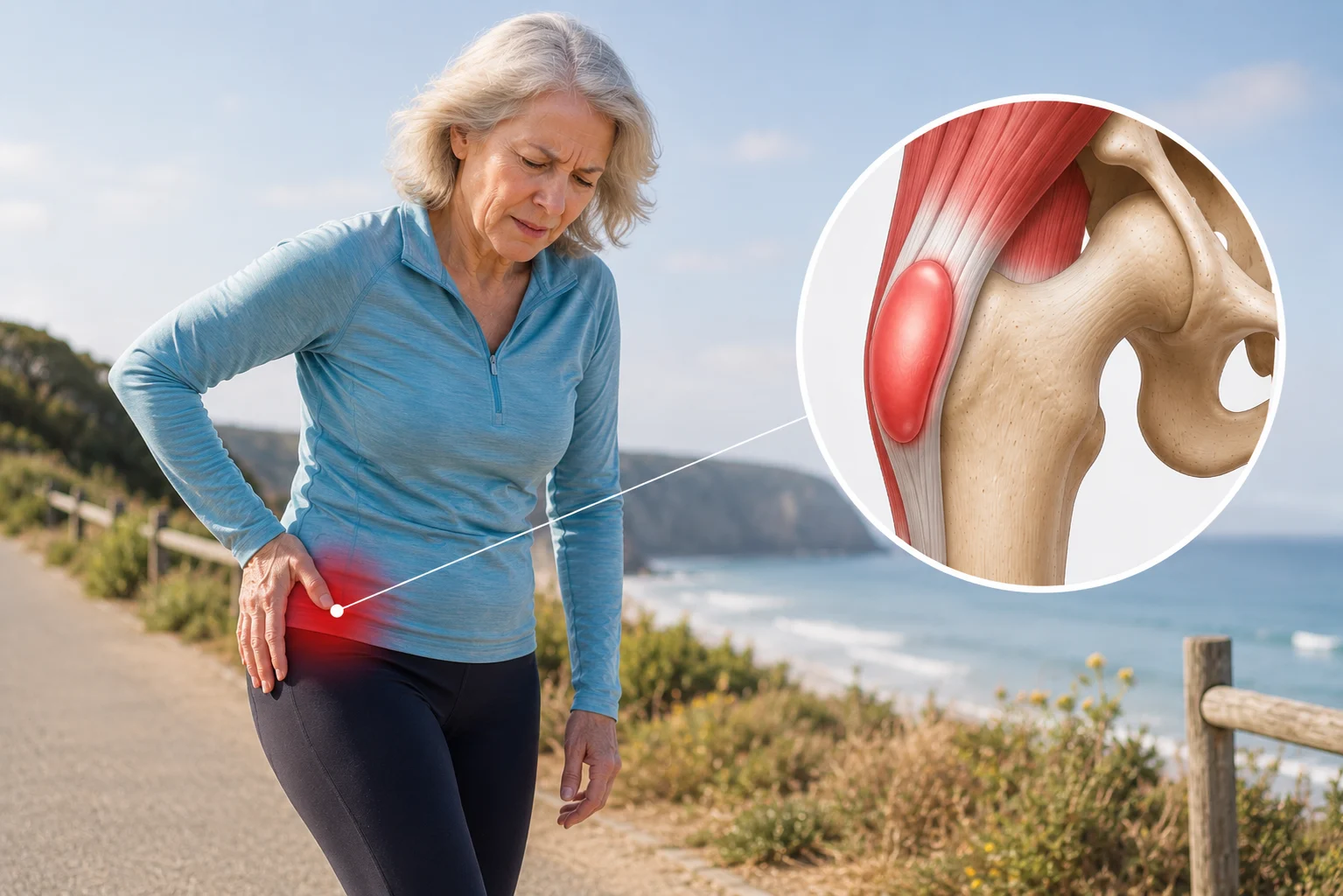
Pain on the outside of the hip is very common, especially in women over 40. It often aches when you lie on that side at night, climb stairs or stand for a long time. Many people are told they have hip bursitis.
In most cases the main source of pain is the gluteal tendons, which attach the buttock muscles to the bony point on the side of the hip. This is called gluteal tendinopathy. The good news is that a clear plan of education and exercise helps most people.
What is gluteal tendinopathy?
Your gluteal muscles hold your pelvis level when you stand on one leg and walk. Their tendons wrap over a bony bump on the side of your hip. A small fluid sac, called a bursa, sits nearby.
When the tendon is overloaded, often by squashing it against the bone, it becomes sore and less able to cope with load. The bursa can become irritated too. The SOS Clinic page on hip bursitis explains the condition in more detail.
What the LEAP trial found
The LEAP trial, run in Brisbane and Melbourne, is the best known study of this condition.1 It included 204 people with lateral hip pain for more than three months. They were split into three groups.
- Education plus exercise. Fourteen physiotherapy sessions over eight weeks, with advice on how to reduce load on the tendon and a home exercise program.
- A single corticosteroid injection. This was given by a doctor as part of the study.
- Wait and see. General advice only.
At eight weeks, both active treatments did better than wait and see. The education plus exercise group did better than the injection group on overall improvement and on pain. At one year, the education plus exercise group still reported better overall improvement than the other groups. Pain levels at one year were similar in the education plus exercise and injection groups, and both were a little lower than wait and see.1
A 2025 review of the best quality trials came to a similar view. Exercise and education had a medium effect on pain and function in the short term and a smaller effect over the longer term. The authors suggested it as the core approach, while noting that more good trials are needed.2
So exercise and education help most people, but the benefit is not the same for everyone, and it takes several weeks of steady work. SOS Clinic does not give injections. The injection group is described here only because it was part of the study.
Easing the load on the tendon
The gluteal tendons are squashed most when your thigh crosses toward the other side of your body. Reducing these positions in daily life is a key part of treatment.1,3
- Avoid crossing your legs. Sit with your knees apart and your feet flat on the floor.
- Stand evenly. Hanging on one hip, with your weight on one leg and the hip pushed out to the side, compresses the tendon. Share your weight across both feet.
- Change how you sleep. Lying on the sore side presses the tendon against the bone. Lying on the good side can also hurt if the top knee drops across the body. Try a pillow between your knees, or lie on your back with a pillow under your knees.
- Sit a little higher. Very low chairs and car seats put the hip into a deep bend. A firm cushion can help.
- Pace your walking. Long walks, steep hills and stairs can flare the pain early on. Shorter, more frequent walks are often easier.
- Be careful with stretches. Stretches that pull the leg across the body, such as some ITB stretches, can squash the tendon and make it worse.
What the exercise program looks like
A program for gluteal tendinopathy usually builds in stages.1,3
- Gentle holds first. Static muscle holds, where you tense the muscle without moving the joint, can ease pain and start to build strength.
- Strength that slowly builds. Exercises progress to standing and functional work, such as bridges, step-ups and sit to stand, with load added over time.
- Control on one leg. Training the hip to keep the pelvis level when you stand, walk and climb stairs.
- Back to your activities. Walking, running, golf or the gym are added back once the tendon tolerates more load.
Some soreness during and after exercise is normal. Your physiotherapist will help you judge how much is fine and adjust the program if pain stays up into the next day.
What if exercise does not help enough?
Most people improve with a good program given a fair trial. A small number have a larger tendon tear or pain that does not settle. For them, surgery such as gluteal tendon repair, ITB release or bursectomy may be considered.4 Read about surgery for lateral hip pain with Prof Phong Tran.
How SOS Clinic can help
The physiotherapists at SOS Clinic in East Melbourne assess your hip, back and walking pattern to confirm where the pain is coming from. You leave your first visit with load advice and exercises you can start at home.
A biomechanical profile assessment can measure hip strength with the VALD ForceFrame and check single leg balance and control with ForceDecks force plates. Repeat testing shows how your strength changes over time.
Myotherapy can ease tight muscles around the hip and back while you build strength.
When to get help sooner
See a doctor promptly if you have hip pain after a fall, cannot put weight on your leg, or have a fever with a hot, swollen hip. The same applies to pain that spreads down the leg with numbness or weakness, or pain that keeps getting worse at rest and at night. During opening hours, contact the clinic. After hours and on weekends, go to your nearest emergency department.
Book a hip physiotherapy assessment at SOS Clinic
Frequently asked questions
Is it bursitis or tendinopathy?
Often both are present. Scans commonly show changes in the gluteal tendons, and the bursa can be irritated as well. The treatment is similar, so the name is less important than the plan.
How long does it take to get better?
Tendons change slowly. In the LEAP trial, the program ran for eight weeks, and most of the gains were still there at one year. Many people need a few months of steady work.
Should I stop walking?
Usually not. Cutting back on long walks and hills for a while can help. Shorter walks on flat ground are often fine. Your physiotherapist can help you find the right amount.
What is the best way to sleep with lateral hip pain?
Try not to lie on the sore side. If you lie on the other side, put a pillow between your knees so the top leg does not drop across. Lying on your back is another option.
Do I need a scan?
Not always. A careful physical assessment is often enough to start treatment. A scan may help if the pain does not improve or a larger tear is suspected.
References
- Mellor R, Bennell K, Grimaldi A, Nicolson P, Kasza J, Hodges P, Wajswelner H, Vicenzino B. Education plus exercise versus corticosteroid injection use versus a wait and see approach on global outcome and pain from gluteal tendinopathy: prospective, single blinded, randomised clinical trial. BMJ. 2018;361:k1662.
- Bremer T, Nicklen P, Fearon A, Morrissey D. The efficacy of gluteal tendinopathy treatments: a systematic review. Clin Rehabil. 2025;39(5):600-17.
- Grimaldi A, Ganderton C, Nasser A. Gluteal tendinopathy masterclass: refuting the myths and engaging with the evidence. Musculoskelet Sci Pract. 2025;76:103253.
- Ladurner A, Fitzpatrick J, O’Donnell JM. Treatment of gluteal tendinopathy: a systematic review and stage-adjusted treatment recommendation. Orthop J Sports Med. 2021;9(7):23259671211016850.