Hip replacement rehab, walking, stairs and getting back to sport
A hip replacement is one of the most successful operations in medicine. Most people walk further and with less pain once they have recovered. Rehab helps you get there, and it helps you keep the strength you need for stairs, longer walks and sport.
Every surgeon and every surgical approach is a little different. Some people are given hip movement precautions in the early weeks, and others are given very few. Always follow your surgeon’s advice on precautions, weight bearing and timelines.
Why the side hip muscles need extra work
The muscles on the side of your hip, called the hip abductors, keep your pelvis level when you stand on one leg. You use them with every step. When they are weak, people often limp or lean to one side as they walk.
Hip arthritis weakens these muscles before surgery, and the weakness does not always go away on its own. One study followed people for two years after hip replacement. Knee strength recovered fully, but the hip muscles on the operated side were still a little weaker than the other side at two years.1 The authors suggested that rehab should target the hip abductors more.1
A recent review found that structured exercise after hip replacement improved hip abductor strength in the first few months, and improved early function. Benefits beyond a year were not clear, and the quality of evidence was mixed.2
Walking
Most people start walking with a frame or crutches soon after surgery. As your surgeon allows, you move to one crutch or a stick, then to walking without an aid.
Your physiotherapist looks at how you walk, not just how far. Common goals are an even step length, standing tall, and keeping the pelvis level. Walking time is built up a little at a time.
Stairs
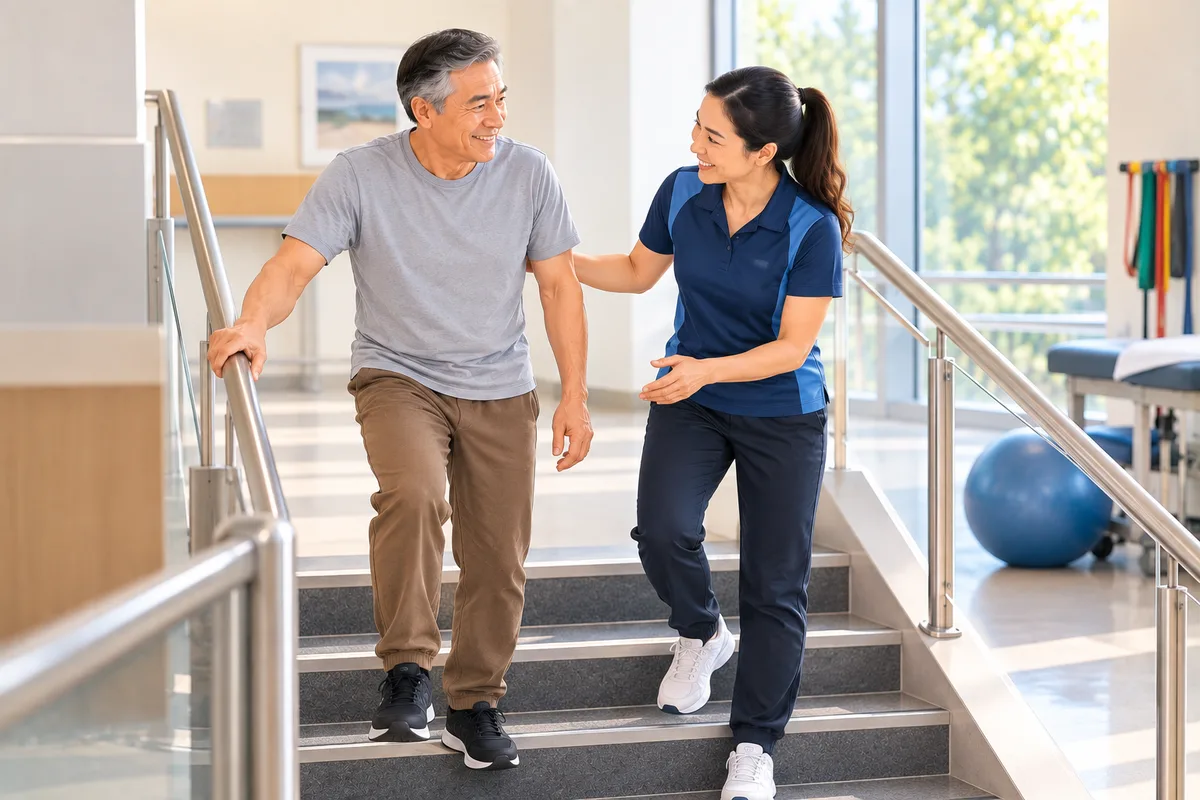
Stairs are often one of the first goals people have. Early on, the usual method is to lead with the stronger leg going up and the operated leg going down, holding a rail. As your strength improves, your physiotherapist will help you move to a normal pattern, one foot per step.
Step-ups, side steps and single leg standing are often used to build the strength and control that stairs need.
Building strength
Once your surgeon is happy for you to progress, strength work usually includes the following.
- Side hip exercises. Side lying leg lifts, side steps with a band and standing hip work.
- Buttock and thigh work. Bridges, sit to stand and step-ups.
- Balance. Single leg standing, first with support and then without.
- Fitness. Walking, a stationary bike or water exercise once the wound has healed and your surgeon agrees.
Exercises are made a little harder over time. Strength can keep improving for many months after surgery.
Getting back to sport
A review of studies on sport after hip replacement found that most people returned to sport. On average they returned to about the same level of sport they did just before surgery, though fewer got back to the level they had before their hip became painful.3 The time to return varied between studies.3
Low impact activities such as walking, cycling, swimming, golf and doubles tennis are commonly resumed. Running and contact sports are a different matter, and the decision belongs to you and your surgeon. Your physiotherapist can then help you build the strength, balance and fitness your sport needs.
How strength testing can help
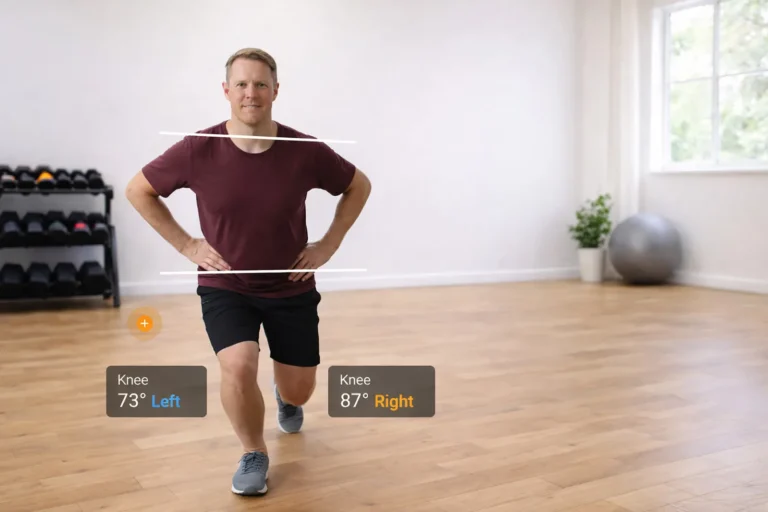
At SOS Clinic, the ForceFrame strength frame measures hip strength on each side, including the side hip muscles. ForceDecks force plates measure how evenly you take weight through each leg, and how steady you are on one leg.
These tests start once your surgeon and physiotherapist agree it is safe. Repeating them shows whether the operated side is catching up. Your physiotherapist uses the results, along with how you walk and how your hip feels, to adjust your program.
How SOS Clinic can help
The physiotherapists at SOS Clinic in East Melbourne see people after hip replacement by any surgeon. They work within your surgeon’s plan and precautions.
A biomechanical profile assessment uses VALD equipment to measure strength, balance and movement, so you can see your progress in numbers.
Prof Phong Tran, who consults from the same clinic, performs hip replacement through an anterior approach, from the front of the hip. Read about anterior hip replacement with Prof Phong Tran.
When to get help sooner
Contact your surgeon or the clinic promptly if your wound becomes red, hot or starts to leak, or you have a fever or chills. Seek urgent care if your calf becomes swollen, tender or painful, or you have chest pain or trouble breathing. The same applies if you feel a sudden clunk in the hip, your leg looks shorter or turned, or you suddenly cannot put weight on it. During opening hours, contact the clinic. After hours and on weekends, go to your nearest emergency department.
Book a physiotherapy appointment for hip replacement rehab at SOS Clinic
Frequently asked questions
Why do I still limp after my hip replacement?
A limp is often caused by weak side hip muscles, stiffness or habit from walking with arthritis. Targeted strength work and walking practice usually help. Tell your surgeon if the limp is getting worse.
When can I drive after a hip replacement?
This depends on your surgeon, which leg was operated on and how quickly you recover. Follow your surgeon’s advice and check with your insurer.
Can I run after a hip replacement?
Some people do, but views differ between surgeons. Talk it through with your surgeon first. If they agree, your physiotherapist can plan a gradual return.
Do I need hip precautions?
It depends on your surgeon and the surgical approach. Some people are given precautions for the early weeks and others are not. Follow the advice you were given at discharge.
Can I see an SOS Clinic physio if another surgeon did my hip?
Yes. The physiotherapists see patients after hip replacement by any surgeon and follow that surgeon’s advice.
References
- Rasch A, Dalén N, Berg HE. Muscle strength, gait, and balance in 20 patients with hip osteoarthritis followed for 2 years after THA. Acta Orthop. 2010;81(2):183-8.
- Ye Z, Yu S, Liao L, Zhang Z, Lv L. Does postoperative exercise after hip arthroplasty improve strength and function? A systematic review and meta-analysis. BMC Musculoskelet Disord. 2026;27(1).
- Hoorntje A, Janssen KY, Bolder SBT, Koenraadt KLM, Daams JG, Blankevoort L, Kerkhoffs GMMJ, Kuijer PPFM. The effect of total hip arthroplasty on sports and work participation: a systematic review and meta-analysis. Sports Med. 2018;48(7):1695-1726.